+2% EXTRA DISCOUNT FOR BUYING ONLINE


Is disposable table linen sustainable? Myths and realities for the hospitality industry

24 August 2026

The search for sustainable disposable table linen has become a priority for restaurants, hotels, catering companies and other businesses in the HORECA sector.

Establishments want to reduce their environmental impact, but they also need to maintain hygiene standards, control costs, streamline service and ensure an attractive table presentation.

Against this backdrop, one question is becoming increasingly common:

Can single-use table linen be sustainable?

The answer requires us to move beyond some overly simplistic assumptions. A disposable product is not sustainable simply because it is made from paper, just as a reusable solution is not necessarily the best option in every situation.

To make a responsible decision, the entire product must be considered: its raw materials, manufacturing process, transport, the quantity used during each service and how it is managed after use.

In this article, we debunk the main myths surrounding disposable table linen and explain which criteria HORECA distributors can use to provide better advice to their customers.

What do we mean by sustainable disposable table linen?

The term sustainable disposable table linen for the hospitality industry refers to single-use napkins, tablecloths, table runners and placemats designed to reduce their environmental impact while still performing their intended function effectively.

To assess whether a solution is more responsible, several factors should be considered:

  • Origin and traceability of raw materials.
  • Amount of material used.
  • Manufacturing processes.
  • Transport distance and efficiency.
  • Product size and grammage.
  • Number of units used per service.
  • Type of packaging.
  • Waste management.
  • Available environmental information or certifications.

Sustainability should not be understood as a single product characteristic, but rather as the result of all the decisions involved throughout its life cycle.

Myth 1: “All disposable products are unsustainable”

A single-use product generates waste once it has fulfilled its purpose. This is a reality that should not be ignored.

However, the number of times a product can be used is not the only factor that determines its environmental impact.

The amount of raw material required, the product’s weight, its manufacturing process, transport distances and the resources required during use also matter.

A lightweight disposable napkin that is appropriately sized does not have the same impact as an oversized solution or one that forces an establishment to use several units per guest.

Therefore, the question should not simply be:

“Is it disposable or reusable?”

We should also ask:

“What resources does this solution require to provide the service the establishment needs?”

Reducing environmental impact begins with avoiding unnecessary consumption, regardless of the type of product chosen.

Myth 2: “Textile table linen is always more sustainable”

Textile table linen can be an appropriate option when it has a long useful life, is used many times and undergoes efficient laundering processes.

However, it also requires resources during its use:

  • Water.
  • Electricity.
  • Detergents.
  • Drying and ironing.
  • Transport to and from the laundry.
  • Handling and storage.
  • Replacement of damaged items.

The final result will depend on factors such as the actual number of washes, the efficiency of the laundry facility, the distance travelled, energy consumption and the lifespan of the fabric.

For this reason, there is no universal conclusion that applies to every HORECA business.

A hotel with its own laundry facilities, a fine-dining restaurant, a high-turnover café and a catering company all have completely different operational requirements.

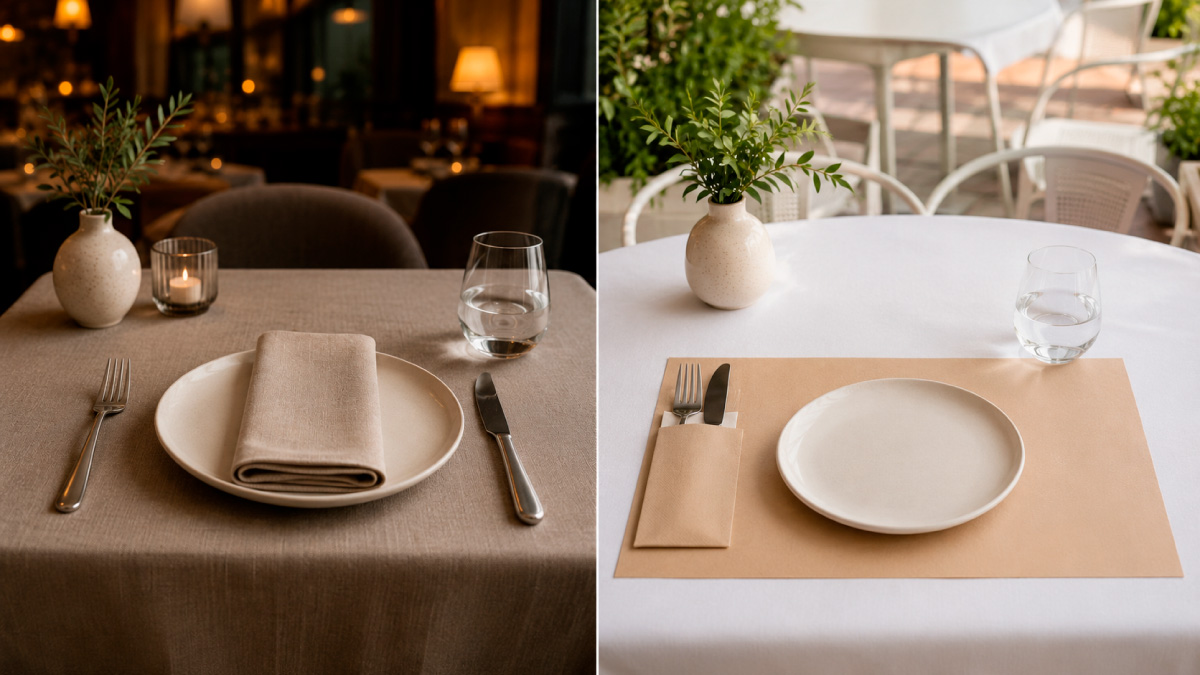
In some establishments, both solutions may even coexist: textile table linen in certain areas and disposable table linen on terraces, at breakfast services, events or services with particularly high turnover.

To explore this comparison in greater depth, you can read our article on paper tablecloths vs fabric tablecloths in the hospitality industry.

Myth 3: “If it is made from paper, it is already sustainable”

Paper comes from a renewable raw material, but not all paper products are the same.

It is also useful to understand the differences between Tissue, Airlaid and Novotela in order to select the most suitable material for each type of service.

When assessing its environmental performance, the following factors should be considered:

  • Origin of the fibre.
  • Traceability of raw materials.
  • Product grammage.
  • Amount of ink used.
  • Efficiency of the production process.
  • Packaging composition.
  • Available certifications.
  • Place of manufacture.

It is also important to consider whether the format genuinely meets the establishment’s needs.

A tablecloth that is larger than necessary results in greater material consumption. Likewise, a napkin with insufficient strength or absorbency may cause customers to use several units during the same meal.

It is therefore not enough to identify the material. It is also necessary to assess how the product has been designed and the type of service for which it is recommended.

Distributors can explore the different ranges of professional table linen and napkins for the hospitality industry to compare materials, formats and performance.

Myth 4: “Biodegradable and compostable mean the same thing”

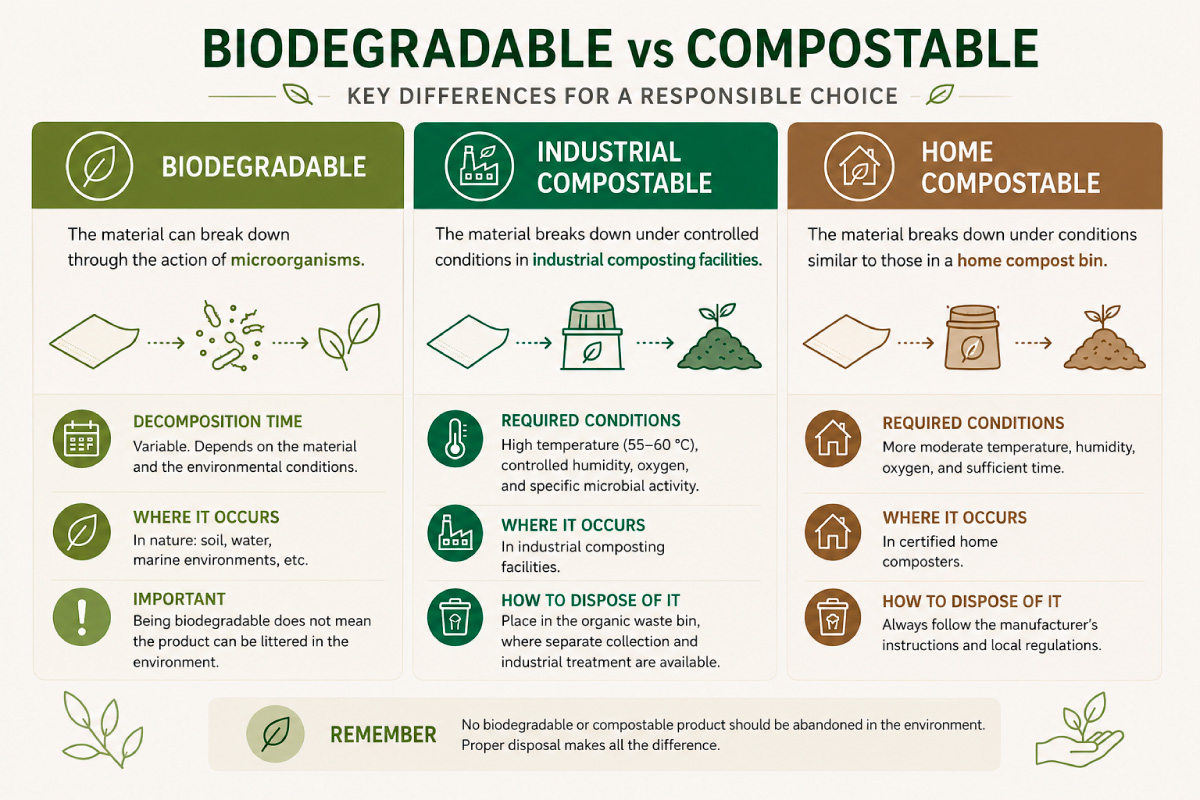
The terms biodegradable and compostable are often used as if they were interchangeable, although they describe different behaviours.

A biodegradable material can break down through the action of microorganisms, but the time required and the necessary conditions can vary.

A compostable product must break down under specific conditions of temperature, humidity, oxygen and microbial activity.

Furthermore, not all compostable products are designed for home composting. Some require specific industrial facilities.

These characteristics should therefore never be interpreted as permission to discard the product in the natural environment.

It is also important to check which collection system is available locally and whether the waste can actually be managed through the disposal route indicated by the manufacturer.

Environmental claims should be clear, understandable and supported by verifiable technical information.

Myth 5: “All single-use products have the same impact”

There are many different types of disposable table linen.

Their impact can vary depending on:

  • Type of raw material.
  • Amount of material.
  • Grammage.
  • Strength.
  • Absorbency.
  • Folding format.
  • Dimensions.
  • Packaging.
  • Transport distance.
  • Number of units used per guest.

One of the most important decisions is to match the product to the type of service.

A café does not necessarily need the same napkin as a high-end restaurant. Likewise, a terrace with small tables can optimise consumption by using placemats whose dimensions are suited to those tables.

Applied sustainability means using the resources required to fulfil a function while avoiding both inadequate performance and unnecessary oversizing.

Choosing the right format and grammage helps reduce unnecessary consumption.

Myth 6: “Sustainability depends exclusively on the manufacturer”

Design and manufacturing are fundamental, but the establishment itself also influences the final impact.

A well-designed product can be used inefficiently if:

  • More units than necessary are placed on the table.
  • An excessively large format is selected.
  • Products are wasted because of inadequate storage.
  • Staff are not properly trained.
  • Waste is placed in the wrong bin.
  • Small, poorly planned orders are placed continuously.

Sustainability is a shared responsibility between manufacturers, distributors, establishments, front-of-house teams and waste management operators.

How to choose paper table linen for restaurants

The choice of table linen also influences the establishment’s perceived value.

Distributors can provide significant added value by helping customers select the product that best suits their operations.

Before recommending a solution, several questions should be answered.

What type of establishment is it?

A hotel, bar, fine-dining restaurant, institutional catering operation or catering company will require different levels of presentation, strength and replenishment.

How many services does it provide?

Daily turnover makes it possible to estimate consumption, storage requirements and order frequency.

How many units does each guest use?

The price per box should not be the only factor considered. Actual consumption per service provides a much more useful perspective.

A higher-performance napkin can reduce the number of units used while improving perceived quality.

What size are the tables?

Choosing the correct dimensions for a tablecloth or placemat prevents more material from being used than necessary.

What image does the establishment want to convey?

Table linen is part of the customer experience. Texture, colour, design and folding should be aligned with the establishment’s positioning.

Does the establishment have laundry facilities?

When there is no in-house laundry, the costs of collection, transport, washing, delivery, sorting and textile storage must also be taken into account.

How is waste managed?

The product’s composition should be considered alongside the actual collection and treatment options available in each location.

How can a distributor help customers make more sustainable decisions?

Beyond simply supplying products, distributors can provide significant added value by helping establishments choose the most appropriate solution for each service.

To do so, it is useful to analyse factors such as:

  • Type of business.
  • Frequency of use.
  • The type of presentation the establishment wants to achieve.
  • Actual consumption per service.
  • Waste management.
  • The balance between functionality, cost and environmental impact.

Providing expert advice makes it possible to identify solutions tailored to each customer and move towards more responsible consumption without compromising operational efficiency.

Materials and solutions for different types of service

There is no single material that is suitable for every customer.

Different alternatives are available within professional table linen solutions.

Paper for functional, high-turnover services

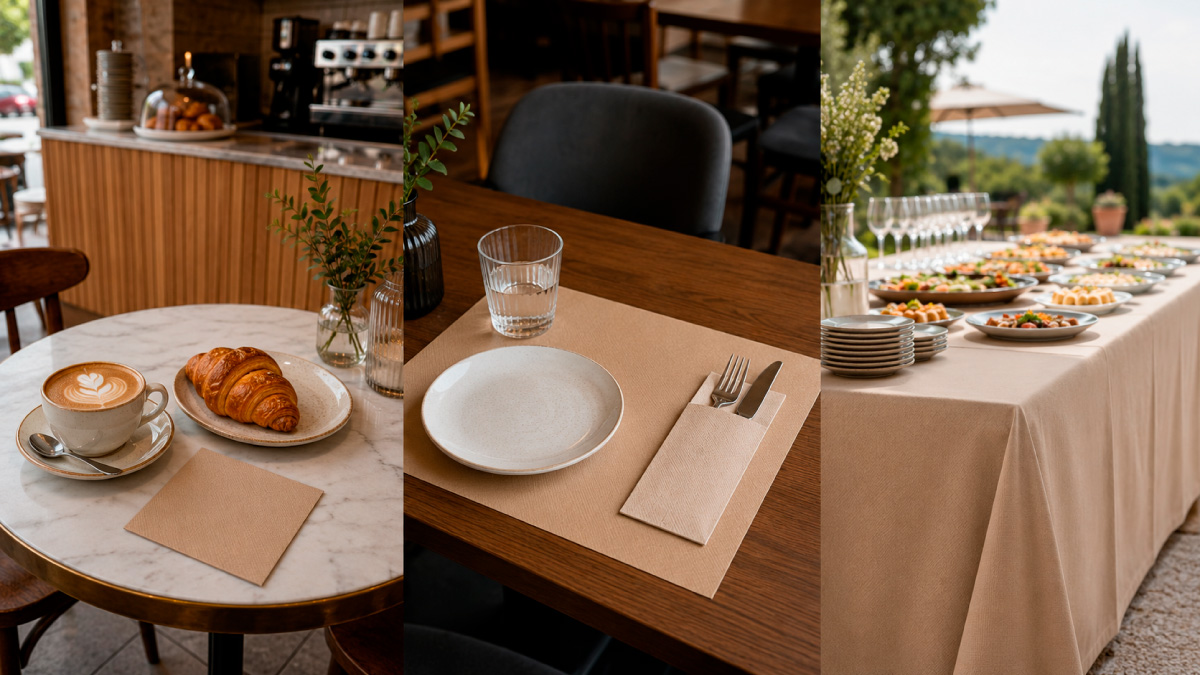
Paper tablecloths and napkins are commonly used in cafés, terraces, fast-service restaurants, institutional catering and businesses that require quick and easy replenishment.

The appropriate format should be selected according to strength, number of plies, absorbency and expected consumption.

Airlaid for a textile-like presentation

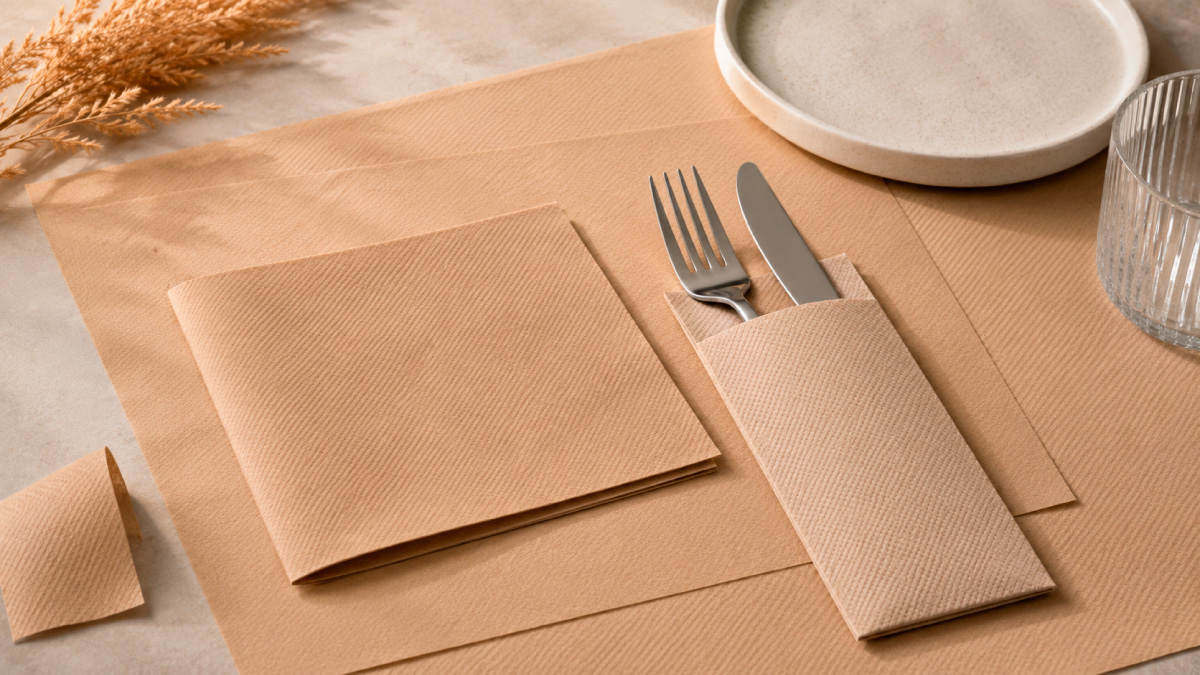
Airlaid provides a texture and appearance suited to establishments seeking a more refined table presentation without introducing a laundry process.

You can explore our Airlaid table linen category and our selection of Airlaid napkins for the hospitality industry.

Newtex for services requiring greater strength

In certain settings, it may be preferable to use more resistant materials, particularly on terraces, outdoor tables or in services where greater surface protection is required.

Explore our Newtex placemats to discover the available formats and applications.

The distributor’s role in more responsible purchasing

A HORECA distributor is more than simply a product supplier. They can also become a specialist adviser to the establishment.

Their role is to help customers find the right balance between:

  • Presentation.
  • Functionality.
  • Hygiene.
  • Consumption.
  • Cost per service.
  • Logistics.
  • Environmental impact.

To achieve this, comparing the total cost per service is more useful than focusing solely on the price per box.

Other indicators can also be analysed, including:

  • Units consumed per guest.
  • Amount of material used.
  • Replenishment frequency.
  • Storage space.
  • Losses and waste.
  • Staff time required.
  • Origin of raw materials.
  • Environmental information and certifications.

This approach makes it possible to offer solutions tailored to each business and build a commercial relationship based on expertise and knowledge.

At La Pajarita, we work to reduce the environmental impact of our activities through initiatives focused on continuous improvement, process efficiency and the responsible use of resources. You can find out more about our commitments and progress in our sustainability strategy.

So, is disposable table linen sustainable?

Disposable table linen cannot be considered sustainable by definition.

Its environmental performance will depend on how it has been designed, the materials used, manufacturing efficiency, the amount consumed and how it is managed after service.

Likewise, a reusable solution should not automatically be considered the option with the lowest environmental impact without analysing its actual conditions of use.

The most responsible choice will be the one that:

  • Performs the required function.
  • Uses an appropriate amount of material.
  • Avoids unnecessary consumption.
  • Is supported by verifiable environmental information.
  • Adapts to the establishment’s operations.
  • Allows for appropriate end-of-life management.

Sustainability in the hospitality industry is not about choosing labels. It is about making better decisions at every stage.

Find the right solution for every HORECA customer

At La Pajarita, we develop table linen and napkin solutions for different types of foodservice businesses, ranging from functional, high-turnover services to establishments requiring a premium presentation.

Explore our table linen and napkin catalogue for the hospitality industry or visit our professional products section to compare materials, designs and formats.

Do you need help selecting the most appropriate solution for a customer?

Contact our team and we will help you assess the format, material and performance characteristics that best suit their establishment.

Frequently asked questions about sustainable disposable table linen

Is paper table linen sustainable?

It depends on the origin of the raw materials, the manufacturing process, grammage, the number of units used and how the waste is managed. Not all paper products have the same environmental performance.

Is it better to use paper or fabric tablecloths?

There is no single answer that applies to every establishment. Material consumption, laundering, transport, textile lifespan, number of services and operational requirements should all be compared.

What should a distributor consider when recommending table linen?

The distributor should consider the type of establishment, turnover, table size, required presentation level, consumption per guest, logistics and waste management.

What is the difference between biodegradable and compostable?

A biodegradable material can break down through the action of microorganisms. A compostable product must break down under specific conditions and may require an industrial composting facility.

Which certifications should be checked when choosing sustainable table linen?

It is advisable to check the origin of the raw materials, the available environmental certifications and the information provided by the manufacturer regarding the product’s environmental performance and its correct management at the end of its useful life.

Comment


Privacy Overview

This website uses cookies so that we can provide you with the best user experience possible. Cookie information is stored in your browser and performs functions such as recognising you when you return to our website and helping our team to understand which sections of the website you find most interesting and useful.